
Bracket racing: what a breakout actually means
Bracket racing is not “who is quicker.” It is a handicap: you declare an elapsed-time index, the tree gives the slower car a head start, and the first to the stripe without going faster than your own number wins. People search what a breakout is because they ran a personal-best and still lost. This page is that rule, said slowly. It is not a sanctioning-body manual and not every track’s house class. The index you wrote on the card is the contract. Beat it and you gave the race away, even if the other lane was late.
Heads-up racing is the opposite contract: same tree, no gift, first to the stripe. Mixing the two in your head is how a first-timer leaves on the last amber like a pro tree and then cannot understand the slip. If the night is a bracket, your job is to be repeatable, not heroic. If the night is heads-up, the sixty-foot you already know how to read still matters — but a breakout does not exist.
What the index is, and what a breakout actually costs
You pick a number you can run twice. The tree starts the slower index first. If you run quicker than the index you declared, that is a breakout: you beat yourself. A red-light is still a red-light. A double-breakout usually hands it to whoever broke out by less, depending on the track sheet — do not assume, ask the tower before you card. The slip will show ET against your index. That gap is the whole sport. A 10.00 car that runs 9.92 in a 10.00 bracket did not “get better.” It lost the contract.
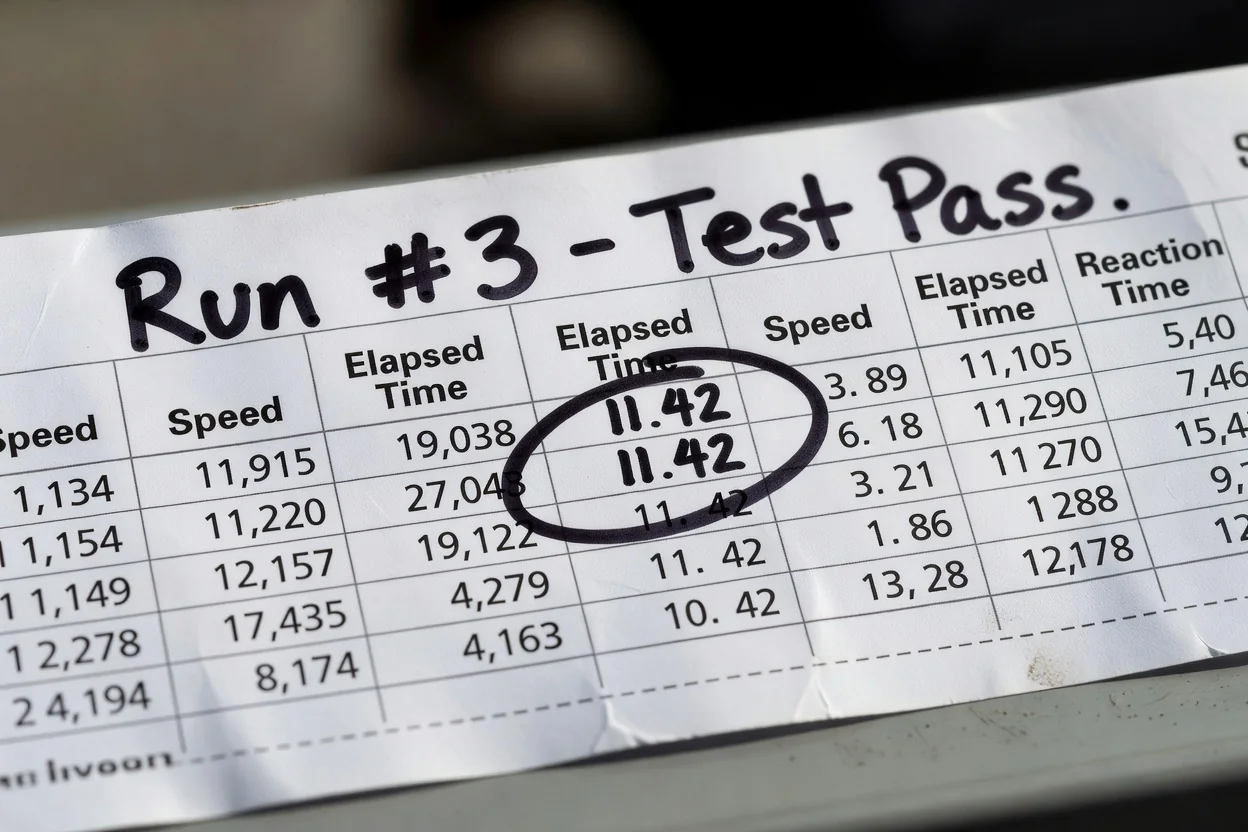
- Write an index you have already run twice in similar air, not the one you hope to run.
- Ask the tower how double-breakouts and red-lights are settled on this night.
- If you are faster than last week, move the index before you card — do not “see what happens.”
- Heads-up class: there is no breakout. Do not lift at the stripe for a number that is not in play.
- One hero pass is not a dial-in. Three consistent slips are.
| You did | In a bracket | Heads-up |
|---|---|---|
| Ran quicker than your index | Breakout — you lose that contract | Just a quicker pass |
| Left before green | Red-light, usually done | Red-light, usually done |
| Ran right on the number | That is the point | Irrelevant as a win condition |
| Lifted early to “save” the index | Sometimes the only save | You just gave the stripe away |
The risk of treating a personal best as a win
The stands will cheer a 9.80. The card said 10.00. Those two facts can live in the same lane and only one of them pays. First test-and-tune in a bracket class: pick a soft index, leave on green, bring back three slips, then tighten. Deep-staging plus a tight dial is how first-timers red-light and break out in the same evening. If you do not yet know which tree you are on, you are not ready to card a number to the hundredth. That is not caution for its own sake. That is how you still have a second pass.

What to write on the card before you pre-stage
An index you can repeat, the house rule for breakouts, and a plan to leave on green rather than chase a personal best. Bracket racing rewards the boring car. Heads-up rewards the fast one. Know which contract you signed tonight. The slip will not explain the difference after you have already given the race away — and a personal best that broke out is still a loss, no matter how good it looked from the fence.