
ET, Reaction Time and the 60-Foot: How to Read a Timing Slip
Every drag strip argument eventually comes down to three numbers: reaction time, the 60-foot clock, and elapsed time. Understand those three and a timing slip stops being a receipt and starts being a diagnosis.
The crew that filmed an 8.09 in Montgomery did not get there by accident. They got there by reading slips, one hundredth at a time. Here is the same education, free of charge.
Elapsed time: the headline number
ET is the time from the moment your car breaks the stage beam to the moment it breaks the finish line beam, a quarter mile (or, increasingly, an eighth mile) away. It is the number on the window sticker, the number in the argument, and the number that decides eliminations — but it is the last thing you should look at when tuning.
Reaction time: the driver's number
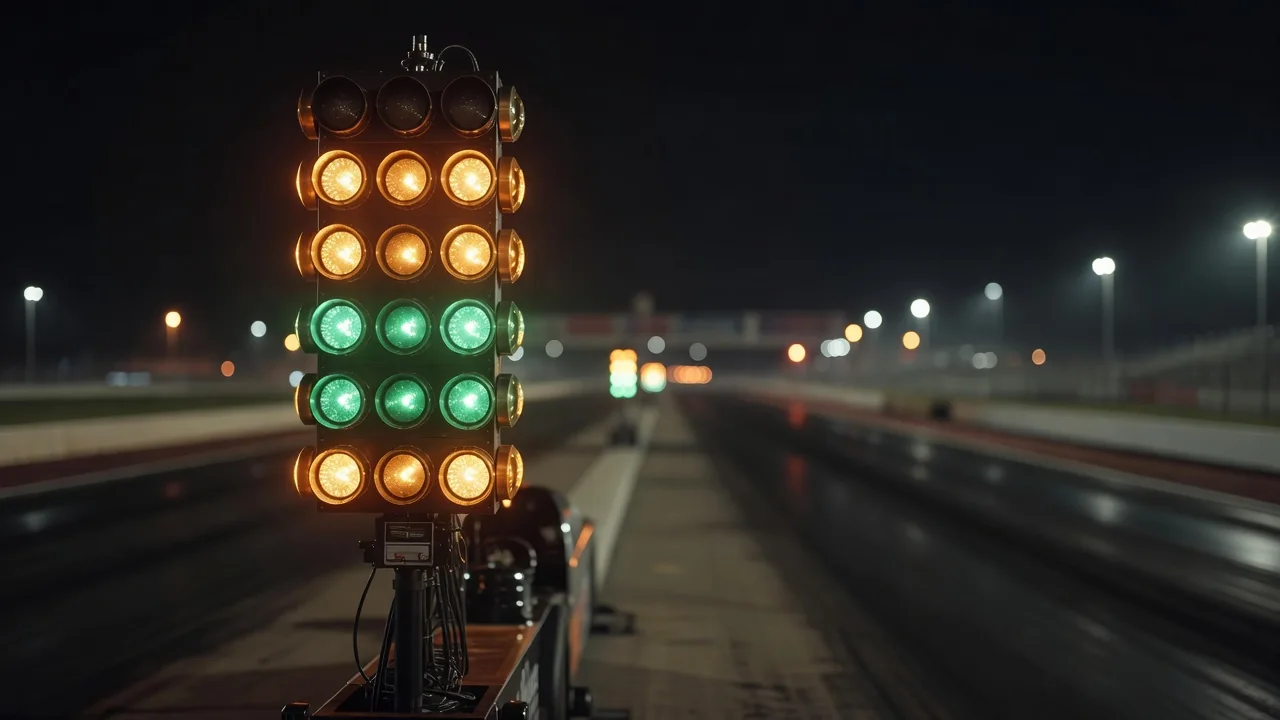
Reaction time measures how long after the green light your car leaves the starting line. A perfect light is .000; anything negative is a red light and, in eliminations, an automatic loss. Street racers raised on "first one across wins" often discover that bracket racing punishes the impatient: leaving .050 early loses to a slower car that left on time.
The 60-foot: where races are won
The 60-foot clock measures the launch. It is the purest traction and suspension report in the sport: a tenth gained in the first sixty feet is typically worth two tenths at the far end. When a car runs 8.09 one round and 8.34 the next, the 60-foot times usually explain the difference before anything else does.
Reading a timing slip
| Measurement | What it tells you | What to change |
|---|---|---|
| Reaction time | Driver's anticipation of the tree | Staging routine, practice tree sessions |
| 60-foot | Launch traction and chassis setup | Tire pressure, shocks, weight transfer |
| 330-foot / 660-foot | Mid-track power delivery | Gearing, shift points, boost or nitrous timing |
| ET and mph | Overall performance | Mph shows horsepower; ET shows efficiency |
Bracket racing: the great equaliser
Most local racing is bracket racing: you dial in a predicted ET, and the slower car gets a head start equal to the difference. Run quicker than your dial and you "break out" and lose. The format rewards consistency over raw speed — which is why a 12-second car with a disciplined driver beats an 8-second car with a loose one, week after week.
First steps for newcomers
- Start at a test-and-tune night, not an eliminator — no pressure, unlimited passes, cheap entry.
- Make one change per session and write everything down: air pressure, launch rpm, weather, results.
- Chase the 60-foot before you chase horsepower; traction is cheaper than boost.
- Watch the fast cars stage: shallow or deep, and how long they hold the brake before the tree comes down.
The stopwatch does not care about your reputation, your stickers or your stories. That is the entire appeal: for nine seconds at a time, the truth is printed on a slip of paper.