
Drag Strip Safety Rules: What Tech Wants Before Your First Pass
Every rule at a drag strip reads like bureaucracy until you learn which bad day wrote it. The tech inspection, the helmet rule, the little metal loop around the driveshaft — each one is a memorial to an accident somebody else already had, so you do not have to. Beginners search this topic because the rulebook is thick and the gate is close, and what they actually need is the shape of the thing: what tech wants, why it wants it, and where the real risks on a drag strip live.
This page is that shape. It is not the rulebook — your sanctioning body prints that and your track enforces it — it is the plain-language tour of what a stock car will be asked, and the few rules that matter more than all the others.
What tech inspection wants from a street car
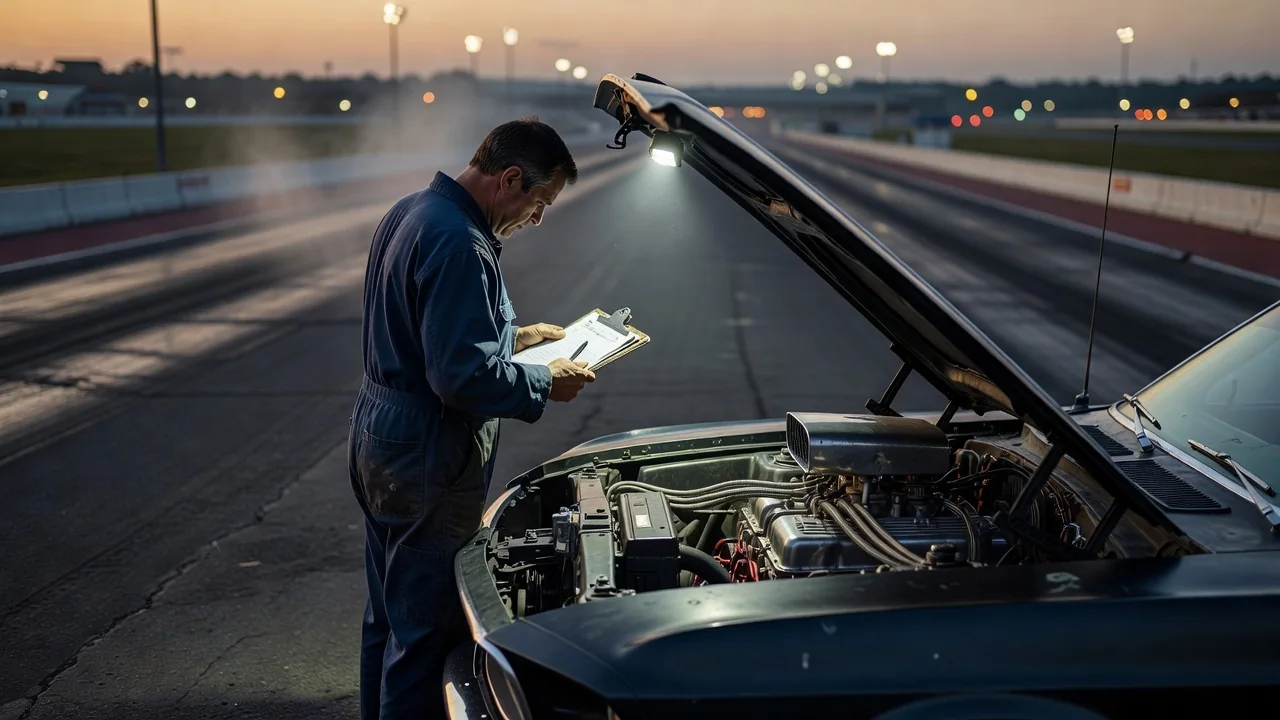
The tech card for a street-driven car is short and mostly free. The inspector wants working brakes, tires with cord safely hidden, a battery that cannot slide into the fan, no fluid leaks, all the lug nuts present, seatbelts that hold, and nothing loose in the cabin that becomes a projectile at the stripe. Coolant catch can, secure throttle return, hubcaps off — the list varies by track, and the track's own website usually prints it. Pass tech and you get the windshield card; that card is your license to make passes, and nobody stages without it.
The rules that scale with your speed
The rulebook climbs a ladder, and every rung is tied to the numbers on your slip. Go quicker than a threshold and the sport asks for more car. A helmet with the right Snell rating appears once your elapsed time drops into the teens. Quicker still and the rulebook wants a roll bar, then a cage, then harnesses, fire gear and a drivetrain built to survive its own torque. The NHRA rulebook and your track's version of it are the source of truth here; the lesson for a beginner is simpler. Do not build toward a rule you have not read, and do not be surprised when a fast night earns you a friendly list of homework from the tower.
Where the real danger lives on track
The scary part of drag racing is not the speed; it is the first sixty feet, where torque, tires and a cold track negotiate. That is where cars get sideways, where axles break, where the other lane crosses into yours. The shutdown area is the second address: the pass is not over at the stripe, and a car that stays in the throttle past the finish or brakes hard in the wrong lane is how good nights end. Drive the whole track — launch, stripe, shutdown, return road — with the same attention, because the ambulance at the top end is there for the people who did not.
The gear that buys you time
The personal equipment follows the same logic as the car rules: it exists to buy seconds. A helmet with a current Snell rating buys them for your head, a fire jacket buys them against a flash fire, and a harness holds you where the belts were designed to work. None of it makes the car faster, and all of it decides what kind of evening a mistake becomes. Buy the helmet early, buy the rated one the rulebook names, and treat every piece of gear as a bet you will be glad you lost.
The etiquette that is actually safety
Half the safety culture at a strip is disguised as politeness. Do your burnout only when the starter waves you forward, because the crew is still on the track behind you. Stage promptly, because a distracted lane is a dangerous one. Never lift the hood and walk away in the staging lanes with the car hot and running. And if something breaks — fluid on the track, a part on the pavement — tell the tower before the next pair stages. The regulars enforce this harder than the officials do, and a beginner who respects it is welcome back.
- Read your track's tech list the week before, not at the gate.
- Empty the cabin completely; a water bottle is a projectile at speed.
- Buy the helmet before the slip demands it, not after.
- Drive the shutdown area like the pass is still happening.
- Report your own leaks and parts; the next pair inherits them.
| Stage of the night | The rule that owns it | The bad day it prevents |
|---|---|---|
| Tech inspection | Brakes, battery, no leaks | Failures at the stripe |
| Staging lanes | Attention, no loose cargo | Chaos at the water box |
| The launch | Starter's signal only | Crew still on the track |
| Shutdown and return | Drive it all the way out | The crash after the finish |
The strip's rulebook is the most honest document in motorsport: every line costs somebody something once. Read the short version your track publishes, bring a car that passes tech without drama, and treat the shutdown area with the respect the launch gets. Do that and the only thing you take home is a slip.